What A 1031 Exchange Actually Costs
A straight look at 1031 exchange costs, what changes the number, and which expenses can quietly create a tax bill if you pay them the wrong way.
Most articles about this dodge the question. They explain that costs vary and then send you to a contact form. We are not going to publish a fee schedule here either, because the honest answer is that the number depends on which type of exchange you run and how complicated the transaction is. What we can do is share that the simplest type of exchange, the forward exchange, only costs $1,000. For more complex exchanges, we can show you every component that goes into the number, so you can ask any provider the right questions.
The short version on 1031 exchange costs
A straightforward delayed or forward exchange is one of the least expensive parts of a real estate transaction. You are paying a neutral third party to hold proceeds and prepare exchange documentation, and that fee sits well below what most sellers expect relative to the tax being deferred. Costs climb when the structure gets more complex, particularly with reverse and improvement exchanges.
What you are actually paying for
The core fee covers the role the IRS requires. Proceeds from your sale cannot touch your hands, so a neutral party holds them and converts the sale into an exchange using specific documentation. That work is administrative, it is time sensitive, and it carries real liability for whoever performs it.
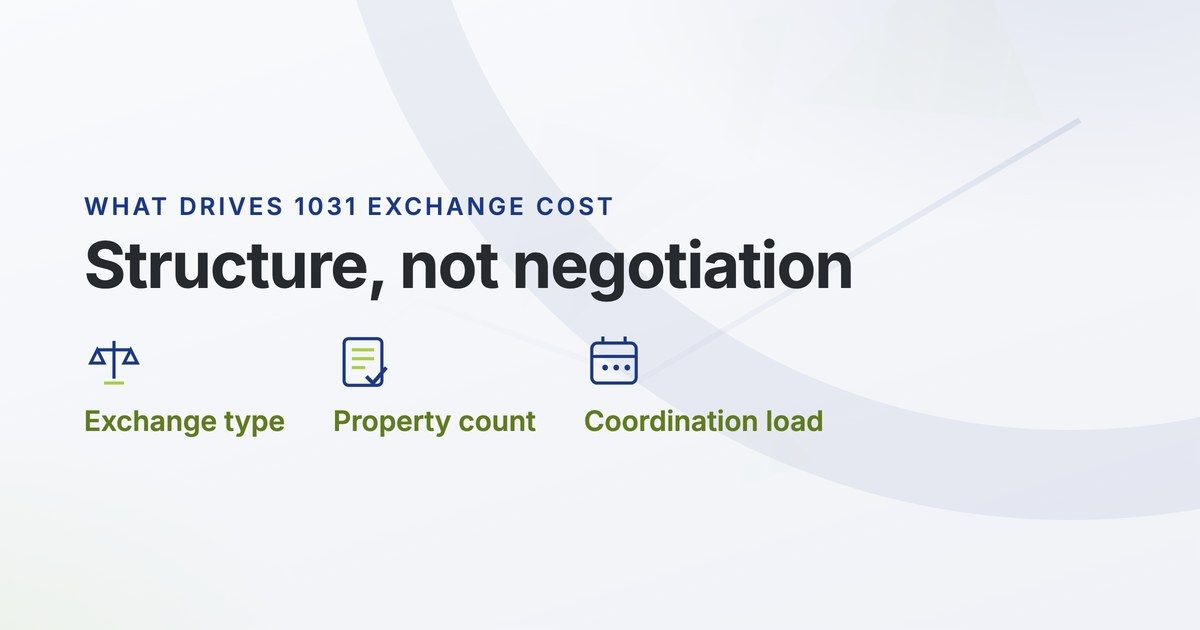
Beyond that base, the things that move the number are structural rather than negotiable.
The type of exchange. A standard forward exchange is the simplest and least expensive. A reverse 1031 exchange, where you acquire the replacement property before selling, requires a holding entity and considerably more work. An improvement exchange, where exchange funds pay for construction on the replacement property, adds another layer again.
The number of properties. Identifying and closing on three replacement properties is more work than closing on one.
How much has to be coordinated. Multiple lenders, a tight closing calendar, or a property that needs an entity created around it all add time.
The costs people forget until closing
This is where the real money hides, and it has nothing to do with what you pay a provider.
Certain closing costs can be paid from exchange proceeds without consequence. Others cannot, and paying them out of exchange funds creates taxable boot even though the money never felt like income to you. Loan related charges are the usual culprit. Prorated rents and security deposits also need handling with care.
The pattern we see is a seller who ran a clean exchange and then picked up an unexpected tax bill from a few line items on the settlement statement. If you want to understand how that mechanism works before you get to closing, read our guide to boot in a 1031 exchange.
Comparing what a 1031 exchange costs against doing nothing
The comparison that matters is not one provider against another. It is the total cost of the exchange against the tax you would owe by selling outright.
For most investment property sales, those two numbers are not close. The deferred tax is usually a multiple of the entire cost of running the exchange. That is why the fee question, while reasonable, is rarely the one that decides the outcome. The decision that matters more is whether the structure fits your situation at all, and whether a different strategy would serve you better.
Do you need an attorney for a 1031 exchange
We get asked this constantly, so here is a direct answer. We are not attorneys and we are not CPAs. We are tax strategists, and we say that plainly because the distinction matters when you are choosing who to work with.
An exchange does not generally require you to retain an attorney in most states. It does require a neutral third party to hold the proceeds and prepare the documentation, and it works best when your CPA is involved early enough to confirm the numbers. What we do is structure the transaction and show you which strategies apply, then work alongside the professionals who advise you. Complex situations, particularly those involving entities or disputes, may well warrant a lawyer, and we will say so when that is the case.
Ask these questions before you commit
Ask what the fee covers and what sits outside it. Ask where the funds are held and how they are secured. Ask what happens to the fee if the exchange fails because you cannot identify a suitable property in time. Ask whether the provider can offer anything other than a standard exchange, because a provider with one product will only ever recommend that product.
That last one is the reason we built the practice the way we did. There are 20 strategies on our shelf rather than one, which means the recommendation you get is not predetermined before you walk in. See the full range of exchange types or take our free course if you would rather learn the landscape first.
When you are ready to talk numbers for your specific transaction, start an exchange with us or get in touch.
FAQ
How much does a 1031 exchange usually cost?
It depends primarily on the type of exchange. A standard forward exchange is the least expensive and sits at the low end of transaction costs relative to the tax deferred. Reverse and improvement exchanges cost considerably more because they require additional entities and substantially more coordination. Ask any provider for a written breakdown before you commit.
Is it worth doing a 1031 exchange?
Compare the full cost of running the exchange against the tax you would owe on an outright sale. For most investment property sales the deferred tax is a large multiple of the exchange cost. The better question is whether an exchange is the right structure for your goals, because deferral commits you to reinvesting rather than taking the cash.
Do I need an attorney to do a 1031 exchange?
Generally no. An exchange requires a neutral third party to hold the proceeds and prepare the documentation, and it benefits from your CPA being involved early. We are consultants rather than attorneys or CPAs, and we work alongside your existing advisors. Situations involving entity structuring or disputes may warrant legal counsel.
What is a poor man's 1031 exchange?
This informal term usually describes attempts to achieve deferral without running a qualifying exchange, such as installment sales or offsetting gains against losses elsewhere. These are real strategies with real uses, but they are not exchanges and they do not carry the same treatment. Anyone describing one as equivalent to a 1031 is oversimplifying.
Note. We are not CPAs or tax attorneys. The information here is for educational purposes only. Do not apply it to your own situation without speaking with a tax professional.