Can You Use A 1031 Exchange On A Primary Residence
A 1031 exchange does not apply to a home you live in. Here is what does apply, and how the rules change when a residence becomes an investment property.
This question comes up in almost every conversation we have with someone selling a home that has gone up in value. They have heard a 1031 exchange defers capital gains tax, they are about to sell, and they want to know whether it applies to them. The short answer is usually no, and the longer answer is where the useful part lives. Since we opened in November 2018 we have walked around 350 clients through some version of this.
The short answer on primary residences
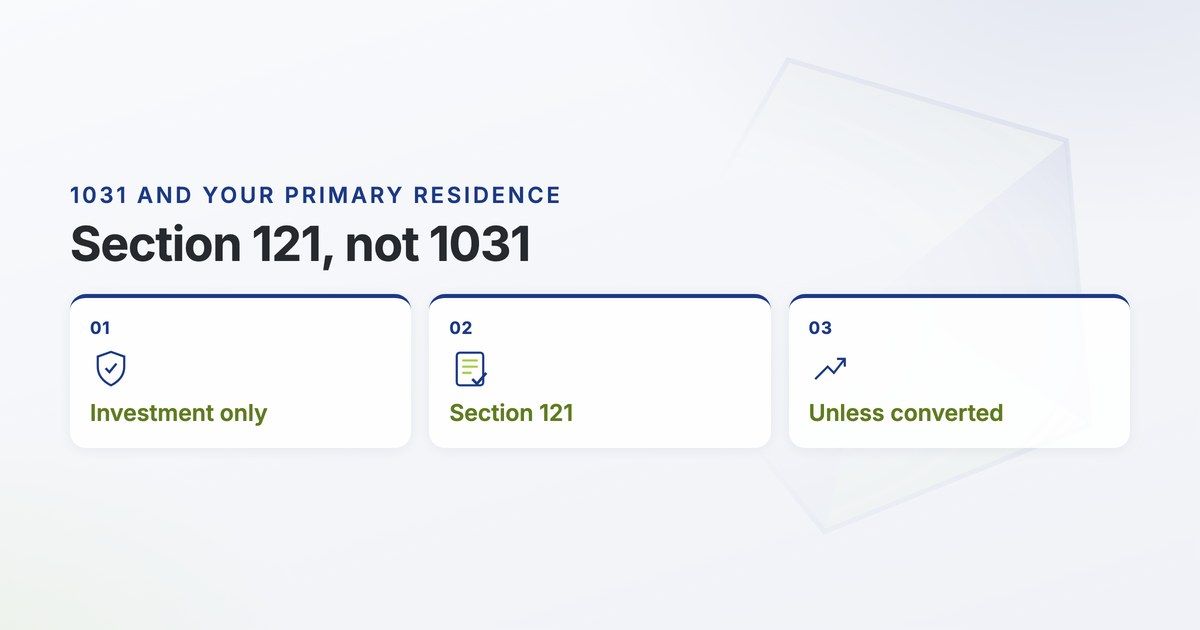
A 1031 exchange cannot be used on a property you live in. Section 1031 applies only to property held for investment or productive use in a trade or business. A primary residence fails that test by definition. Homeowners selling a residence usually look to the Section 121 exclusion instead, which is a different rule with different limits.
That is the clean version. In practice most people asking us this question are not in a clean situation.
Where the line actually sits
The rule is about how the property is held, not what the building looks like. A duplex where you live in one unit and rent the other is partly investment property. A house you lived in for a decade and then rented out for three years has changed character. A vacation home you occasionally rent has a use history that determines the answer.
The IRS looks at intent and at your actual pattern of use. That is why two people selling identical houses on the same street can get two different answers. Our answers to common questions work through several of these use cases.
Converting a rental into a home you live in
This is the version of the question we see most often, and it runs in the opposite direction from what people expect. You cannot 1031 out of your home. You can, in some circumstances, 1031 into a property that you later convert into a residence.
The sequence matters enormously. The replacement property has to be acquired and held with genuine investment intent. Converting it to personal use too quickly undermines that intent, and the safe harbor guidance most advisors work from looks for the property to be rented at fair market value for a meaningful period, typically two years, before any conversion. Get the order wrong and the exchange that looked complete becomes a taxable event years later.
If you want the mechanics of how the exchange itself runs, read the full 1031 exchange process before you plan a conversion.
When you are selling a residence and not an investment
Plenty of people arrive at this question because they are downsizing. The house is worth far more than they paid, the children have gone, and the tax bill on the sale is the thing standing between them and the next stage of life.
A 1031 exchange is not the tool for that. But it is not the only tool, and this is the part most articles skip. There are strategies built specifically for appreciated property that does not qualify for an exchange, and for sellers who want to convert a large illiquid asset into something that produces income. If that is your situation, see our downsizing strategy, which was built for exactly this case.
We work with 20 different tax deferral strategies. Only some of them are exchanges. When someone comes to us with a residence rather than an investment property, the conversation usually moves to one of the others, such as a deferred sales trust or a Qualified Opportunity Zone if there is investment property in the mix.
A quick example of how the two rules interact
Consider a couple who bought a house, lived in it for eight years, then moved and rented it out for three years before selling. That property has a mixed history. Part of the gain may fall under the residence exclusion and part may relate to the period it was held as an investment, and depreciation taken during the rental years does not simply disappear.
We are not going to give you a number here, because the answer depends on dates, depreciation, and how the property was reported. What we can tell you is that mixed use histories are common, they are not disqualifying, and they need to be mapped before you sign anything.
What to do before you sell
The single most expensive mistake in this area is timing. Once a sale closes and the proceeds reach you, the options narrow sharply. The most powerful strategies are structured before the closing, not after.
If you are within a few months of selling, that is the moment to have the conversation. Start an exchange with us or book a complimentary consultation and we will map what actually applies to your property before the sale closes.
FAQ
What is the 2 year rule for 1031 exchange?
The two year reference usually points to holding periods that demonstrate investment intent. Related party exchanges carry a two year holding requirement on both sides, and conversion cases often look at a two year window of qualifying use split across the years before and after the exchange. Which one applies depends on your transaction, so confirm it against your own facts.
What is the downside of a 1031 exchange?
The deferral is not forgiveness. Your basis carries forward into the replacement property, so the gain follows you. You also accept strict deadlines, you must reinvest through a neutral third party rather than touching the proceeds, relinquished property depreciation is carried forward, and you narrow your choice of replacement property. For some sellers the tax cost of simply selling is worth the freedom.
How to reduce capital gains on a primary residence?
The Section 121 exclusion is the usual route for a residence, subject to ownership and use tests and to statutory limits. It is a different provision from Section 1031 and the two are frequently confused. Where a property has both residential and investment history, the two rules can interact, which is worth mapping before a sale rather than after.
How long after a 1031 exchange can you convert to a primary residence?
There is no single number that applies to everyone. The guidance most advisors rely on looks for the replacement property to be held and rented at fair market value for a meaningful period, commonly discussed as two years, with genuine investment intent throughout. Converting early is the risk, because it undermines the intent the exchange depended on.
Note. We are not CPAs or tax attorneys. The examples here are for educational purposes only. Do not apply them to your own situation without speaking with a tax professional.