The Drop and Swap 1031 Exchange Falls Apart When One Partner Signs First
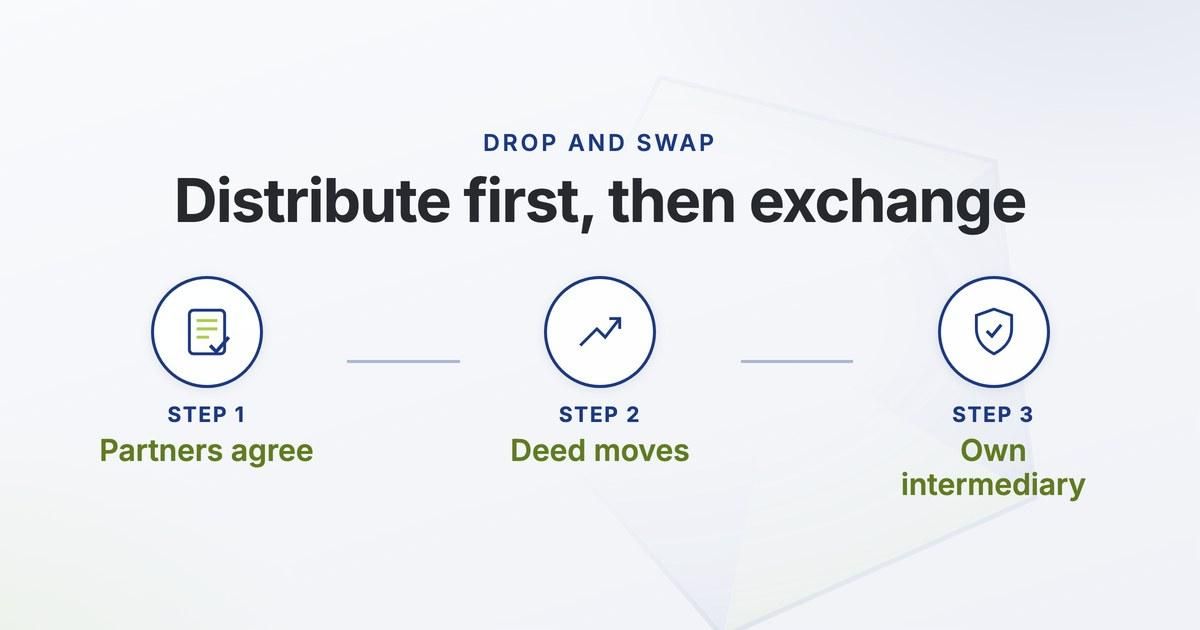
A drop and swap is the move co owners use when a partnership holds property and the partners don't all want the same outcome. The partnership distributes the real estate to the partners as tenants in common, which is the drop. Each owner then goes their own way, exchanging or cashing out, which is the swap.
It sounds tidy written down. In practice it's the most common way a co owned exchange gets into trouble, and the trouble almost always starts with timing rather than with structure.
What a drop and swap does, in one paragraph
The move exists to change who the taxpayer is before the sale, because a partnership interest cannot be exchanged.
Section 1031 applies to real property held for productive use in a trade or business or for investment. A partnership interest isn't real property, so a partner who wants to defer can't exchange their share of the entity. The property itself qualifies, but the partnership owns it, which makes the partnership the only party in a position to exchange. If two of four partners want cash and two want to keep deferring, the partnership can't do both at once. The drop converts each partner into a direct owner of a fractional interest in the real estate, and from there each one can make their own choice.
The moment this comes up, and why it is usually late
By the time most people hear the phrase drop and swap, the property is already under contract.
The sequence that causes it is ordinary. Four people bought a building through an LLC years ago. One of them is retiring, one is going through a divorce, one wants to keep investing, and the fourth hasn't thought about it. A buyer appears at a good price, everyone says yes, and only in the run up to closing does somebody mention they were hoping to roll their share into something else.
That's the moment this post is written for. Page one is law firms and accountants writing for other advisers, which is useful if you're the adviser and not much help if you're the co owner who's just found out their partner wants cash. What we'd tell you on the phone is that the conversation you need to have is with the other owners, and you need to have it before anyone signs anything.
When should you not do a 1031 exchange?
Don't do one when you want out. An exchange commits you to buying more real estate on a fixed schedule, so it's the wrong instrument for a partner who needs cash, wants to stop managing property, or has a small gain relative to the cost of the transaction. It's also wrong when the property was held primarily for sale, which never qualifies.
In a co owned deal that answer does real work, because it splits the asset honestly. The two partners who want out should stop treating the exchange as the default and price the tax. The two who want to defer shouldn't be dragged into a structure built for someone else's goal. Those are different problems with different answers, which is the entire argument for separating the ownership first.
What the partnership actually has to do first
The distribution has to be a real distribution, documented and effective before the sale, not a note in the file afterwards.
That means the operating agreement gets read, the partners agree in writing, the deed moves the fractional interests into the individual owners' names, and the tenancy in common arrangement is set up so each owner genuinely holds an undivided interest in the real estate. Each exchanging owner then needs their own qualified intermediary arrangement in place before the relinquished property transfers. We've written separately on what a qualified intermediary does, and the rule that the money can never pass through the seller applies to each co owner individually once they're exchanging in their own name.
One route that gets missed is worth knowing. Section 1031(e) says that an interest in a partnership which has a valid election under section 761(a) to be excluded from all of subchapter K is treated as an interest in each of the assets rather than an interest in a partnership. That election isn't available to every venture and it has to be in place already, but where it exists the drop may not be necessary at all. The text is in section 1031 itself, which is also where the deadline every co owner is about to inherit lives. Once the relinquished property transfers, the statute gives each exchanging owner 180 days to complete, and it runs from the transfer rather than from the day the partners finally agreed.
There Is No Statutory Holding Period
There's no statutory holding period for a drop and swap, and anyone who quotes you a safe number is telling you about a habit rather than a rule.
The real requirement is in section 1031(a)(1), which needs the property to be held for productive use in a trade or business or for investment. The question is whether the individual owner held it that way, and an interest distributed the week before closing gives a thin answer. That's a facts and circumstances test, not a calendar. Some advisers prefer the drop to happen a year or more ahead and some structure it much closer in, and the disagreement among them is genuine.
What we can tell you without hedging is that the risk moves with the gap. The shorter the interval between the distribution and the sale, the more the arrangement looks like the partnership exchanged and dressed it up afterwards. We won't give you a number the client's own file can't support, and you should be wary of a firm that does.
What Happens If the IRS Disagrees
The risk is that the IRS treats the partnership as the real seller and the exchange fails for the partners who deferred.
If that happens, the gain those partners thought was deferred is recognized, and it's recognized in a year they've already planned around. The reporting is its own exposure, since the exchange gets reported on Form 8824 and the partnership return has questions about distributions in the same year. The two documents need to tell the same story. Some state returns ask directly about property distributed to partners before a sale, which is why this structure is better known to practitioners in high tax states than elsewhere.
One related trap catches family partnerships in particular. What is the 2 year rule for 1031 exchanges? It's section 1031(f), and it says that when you exchange with a related person and either side disposes of the property before the date two years after the last transfer, the nonrecognition is taken away. Co owned buildings are often owned by siblings, parents and children, or entities they control, so a partner buying out another partner's fractional interest can land inside that rule without anyone intending it.
None of that makes a drop and swap improper. It's a widely used and long established structure. It means the structure earns scrutiny, and it rewards being done early, documented properly and reported consistently.
What to do before anyone signs anything
Get the owners into one conversation before the listing agreement, because after the contract your options narrow every week.
Take Ray and Dolores, two of four owners in a small retail building. Ray is retiring and wants cash. Dolores wants to stay invested and defer. If they raise it early, the partnership can distribute the interests, Ray can sell his and pay his tax, and Dolores can run her own exchange with her own intermediary. If they raise it at closing, Ray's cash is straightforward and Dolores has a deferral that may not hold, which is a bad trade for the one who did the planning.
We place 17 different tax deferral strategies for real estate, which matters here because a partner who wants out isn't limited to cash. Depending on the situation an opportunity zone investment or a deferred sales trust can give a retiring owner a route that doesn't force the others to abandon their exchange. That's the conversation worth having early.
If your co owners aren't aligned yet, ask us a question before the property goes on the market, or start an exchange once you know who's doing what. Thanks, Chris Shockowitz and Carl Worden.
Note. We're not CPAs or tax attorneys. Ray and Dolores are a teaching scenario and not a real client. Don't use any of it for your personal financial situation without speaking with a tax professional.
FAQ
What are the changes to the 1031 exchange rules in 2026?
Nothing about the structure of a drop and swap has changed. The rule that still governs what qualifies is the 2017 change that limited section 1031 to real property, which is why partnership interests, equipment and other personal property no longer work. Forms and thresholds are refreshed annually, so check the current section 1031 text and the IRS instructions before you rely on a figure you read anywhere, including here.
What is a poor man's 1031 exchange?
It's slang rather than a provision, and it usually describes an installment sale that spreads gain over several years, or simply refinancing and keeping the property. For a co owner who wants out of a shared building, an installment sale is worth pricing honestly against an exchange, because it can be simpler and the goal is cash rather than more property. It doesn't give you the deferral an exchange does, and nobody should sell it to you as though it does.