Partial 1031 Exchange And What Happens When You Cannot Reinvest Everything
You do not have to reinvest every dollar to use a 1031 exchange. Here is how a partial exchange works and what it costs you in tax.
There is a persistent belief that a 1031 exchange is all or nothing. Reinvest every dollar or do not bother. That is not how the rule works. You can reinvest part of your proceeds, defer tax on that portion, and pay tax on the rest. Whether that is a good idea depends entirely on why you are doing it, and the answer is different for a seller who wants cash than for a seller who simply cannot find property in time.
What a partial 1031 exchange is
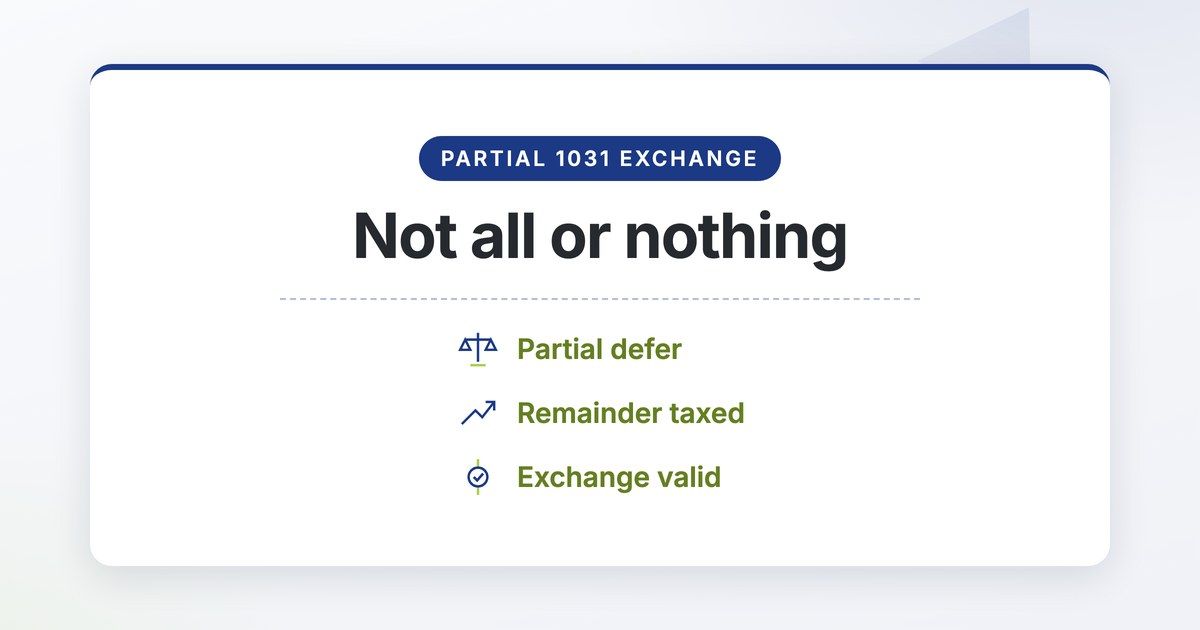
A partial exchange is one where you reinvest some but not all of your sale proceeds into replacement property. The reinvested portion is deferred under the normal rules. The remainder is boot, and it is taxed in the year of the exchange. The exchange itself remains valid.
The two reasons people end up here
The distinction matters more than the mechanics, because it changes what you should do about it.
You want cash. You are selling an investment property and you need a portion of the proceeds for something specific. A partial exchange is a legitimate, deliberate choice.
You cannot find replacement property. You are in the identification window, the market is tight, and nothing suitable is available at the value you need. This is not a choice. It is a shortfall, and it is the situation where most of the money gets lost unnecessarily.
The first case is a decision. The second case has options most sellers never hear about.
An example of the arithmetic
Consider an investor we will call Denise. She sells a rental property for eight hundred thousand with no mortgage. Her basis is two hundred thousand.
To defer the full gain she needs to acquire replacement property worth at least eight hundred thousand. She finds one she likes at six hundred and fifty thousand.
She has four options.
- Buy the six hundred and fifty thousand property and pay tax on the hundred and fifty thousand shortfall. This is a partial exchange, and she is deliberately accepting the tax. She does not love this, but she can live with it.
- Buy nothing, let the exchange fail, and pay tax on the entire gain. She really does not like this.
- Stretch to a larger property she does not actually want, purely to absorb the proceeds. She has seen other investors do this and regret it.
- Buy the six hundred and fifty thousand property she wants, and direct the remaining hundred and fifty thousand into a Delaware Statutory Trust as additional replacement property. She keeps full deferral, she gets the property she chose, and the remainder goes into institutional real estate she does not have to manage. She liked this one.
Option four is the one that rarely appears in general explanations of partial exchanges, and it is available in most of the situations where a shortfall appears.
The fallback ladder we actually use
When a client is facing a shortfall, we work down a sequence rather than accepting the first outcome.
A DST can take the remainder as qualifying replacement property, in an amount that matches what is left over rather than requiring a whole building.
Where an exchange has already failed and proceeds have been released, an opportunity zone investment runs on different timing rules and can still address the gain in some circumstances.
Where the situation calls for something structurally different, a deferred sales trust addresses the problem from another direction entirely.
Twenty strategies, used individually or stacked together. That is the whole reason a shortfall does not have to end in a tax bill.
What a partial exchange costs you
Be clear eyed about the arithmetic before choosing it deliberately.
The boot is taxed in the year of the exchange. The character of that tax matters, because the recognized portion may be treated as depreciation recapture before capital gain, which can carry a higher rate than sellers assume. And the deferred portion still carries its accumulated basis position forward into the replacement property.
None of that makes a partial exchange wrong. It makes it a decision that should be priced in advance.
When taking the cash is the right answer
There are situations where we tell people a partial exchange is exactly what they should do.
An investor who needs a specific sum for something concrete, a business purchase, a medical situation, a property for a family member, is better served taking that amount as boot than distorting the whole transaction around avoiding it. The tax on a defined slice is a known cost. Building an exchange you do not want in order to avoid it is not.
In some cases, where the investor has $1 million or more in equity and debt, we can use a Special version of the Delaware Statutory Trust to return 85% of the investment capital tax free.
The same applies to an investor who is deliberately reducing exposure. Someone stepping back from active real estate may want less capital deployed, not more. Forcing full reinvestment to preserve deferral runs against the actual objective.
What we push back on is the version where the boot is accidental. A seller who wanted full deferral, could have had it, and gave up a portion because nobody modeled the shortfall until the closing statement arrived.
Reporting and the paperwork side
A partial exchange is reported like any other like kind exchange, with the recognized portion shown alongside the deferred portion. The calculation pulls together your adjusted basis, the values on both sides, any debt relief, and any exchange expenses that were paid from proceeds.
That is genuinely work for your CPA. What matters from your side is that they have the closing statements from both transactions and the exchange documentation before they start, because reconstructing it later is where errors appear. If you want to see how the underlying transaction is structured before that point, see how a delayed exchange runs.
A note for real estate professionals
If you work with investors, this is worth knowing about, because it changes conversations that currently end badly.
The seller who will not list because the tax bill is too large, and the seller who is mid exchange and cannot find anything to identify, are both situations where a shortfall solution keeps the transaction alive. We are nationwide educators on tax deferral and we run sessions for real estate offices at no cost. Your clients remain your clients and we charge you nothing.
If that would be useful for your office, get in touch or see our video library first.
Deciding before the clock runs out
Partial exchanges are usually decided under time pressure, inside a 45 day identification window, which is the worst possible condition for a decision of this size. The alternative is to map the fallback options at the start, so that a shortfall becomes a choice you already understand rather than an emergency.
Start an exchange with us or book a complimentary consultation and we will build the ladder before you need it.
FAQ
Can a partial 1031 exchange be done?
Yes. You can reinvest part of your proceeds and defer tax on that portion while paying tax on the remainder, which is treated as boot. The exchange remains valid. What many sellers do not realize is that a shortfall can often be absorbed by additional qualifying replacement property instead.
How to report partial 1031 exchange on tax return?
Like kind exchanges are reported on the relevant IRS form for the year of the exchange, showing both the deferred portion and the recognized boot. The calculation involves your adjusted basis, the values on both sides, and any debt relief. This is work for your CPA rather than something to attempt from a summary.
What is the 2 year rule for 1031?
The two year reference most often relates to related party exchanges, where both parties are generally required to hold their properties for two years, and to holding period questions where investment intent needs to be demonstrated. Which applies depends on your transaction.
What is a lazy 1031 exchange?
This informal term usually describes offsetting a taxable gain with losses generated elsewhere, often through depreciation from another investment, rather than running an actual exchange. It is not a 1031 exchange, it does not follow the same rules, and it produces a different outcome. Treat the two as separate strategies.
Note. We are not CPAs or tax attorneys. The example above uses invented figures for educational purposes only. Do not apply it to your own situation without speaking with a tax professional.