The 1031 Exchange Timeline From the Day You Close
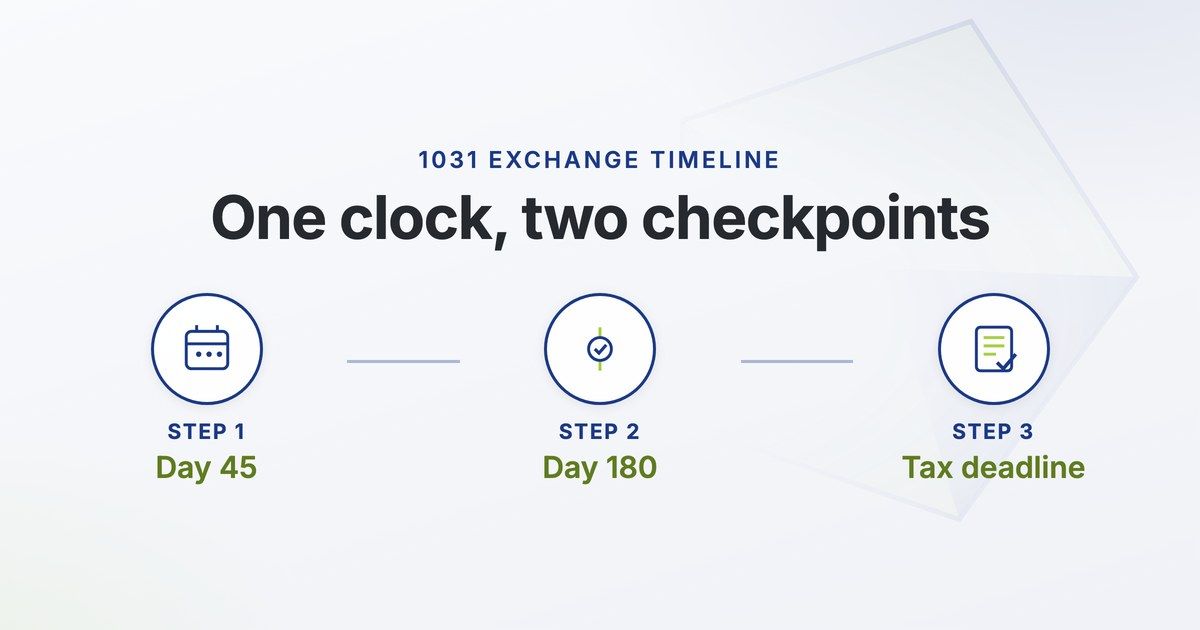
Two numbers run a 1031 exchange, 45 and 180, and almost everybody learns them in the wrong order. They are not two separate deadlines. They are one clock with a checkpoint in it, and both start on the same day.
What the 1031 exchange timeline is
Both clocks start the day your relinquished property transfers. You have 45 days from that day to identify replacement property in writing, and 180 days from that day to receive it. There is a catch on the second one. The deadline is 180 days or the due date of your tax return including extensions, whichever comes first.
Day 0, and why the day before it matters more
Day 0 is the day the property you are giving up transfers. Everything counts forward from there, in calendar days, including weekends and holidays, with no extension for a deadline that lands on a Sunday.
The day that actually decides whether you have an exchange is the day before. The exchange agreement has to be signed and the intermediary assigned into your contract before that closing happens. Once the proceeds have moved, the transaction is a sale and no paperwork afterward converts it back. If you take one thing from this piece, take that.
Days 1 to 45, the identification window
Inside 45 days you must identify your replacement property in writing, signed, and delivered to your intermediary. The IRS Instructions for Form 8824 state that the replacement property must be identified within 45 days after the property being given up is transferred.
The identification rules give you room, and most sellers use less of it than they should. You can name three properties of any value. You can name more than three if their combined value stays inside a defined limit relative to what you sold. Naming a single property and nothing else is the most common self inflicted wound in this business, because a deal that falls through on day 38 leaves you with no list and no time.
We go through the identification rules and their edge cases in detail in the 45 day identification window, so this piece stays on the clock rather than re-arguing them.
Days 46 to 180, the acquisition window
After day 45 the list is closed. You may buy any property on it and nothing that is not.
The 180 day figure is where people get caught. The IRS instructions are explicit that the replacement property must be received within 180 days, or by the due date of your tax return including extensions, whichever is earlier. A sale that closes in November gives you 180 days on paper, but your return is due in April, so unless you file an extension the real deadline moves forward by weeks. Filing the extension is routine and forgetting to is not recoverable.
Most of these transactions are delayed exchanges, which is the situation described here. If you need to buy before you sell, the reverse exchange runs on the same 180 days with a different structure, and the delayed exchange page sets out the standard version.
What the clock looks like with real numbers
Dave and Marisol are selling a rental duplex. Net sales price is $1,200,000 and their adjusted cost basis is $400,000, so they are looking at $800,000 of gain if they simply sell. They close on 3 March.
That makes day 45 the 17th of April and day 180 the 30th of August. Their return is due in April, so they file an extension in week one, which pushes the tax filing date past August and leaves the full 180 days intact. That is a five minute job in March that buys them four months in August.
They have three options for the identification list.
They identify one property, a twelve unit building they have wanted for two years. They love this idea.
They identify three properties, the twelve unit building plus two smaller buildings they would accept. They do not love this idea, because two of the three are compromises.
They identify nothing and let the clock run out. They really do not like this idea, because on day 46 the exchange is over and the $800,000 of gain lands on their return.
They take the second option. On day 38 the twelve unit building falls out of contract when the survey comes back wrong. Because they named alternates, they close on the second building on day 141 and the exchange completes.
Taxes are now triggered? Yes and no. The gain is deferred rather than forgiven, and it follows them into the replacement property as a reduced basis, which is exactly the trade a 1031 exchange makes.
Adding it up. One extension filed in March and two extra names on a list in April are the entire difference between deferring $800,000 of gain and paying tax on it.
How the two clocks interact with your tax return
This is the part of the timeline that costs people money quietly, so it is worth its own section.
The 180 days are not really 180 days. They are 180 days or your tax filing deadline including extensions, whichever arrives first, and for anything sold in the last quarter of the year the filing deadline is the one that arrives first by a wide margin.
Work an example. A property that transfers on 15 November has day 180 falling in mid May. An individual return is due in mid April. Without an extension the exchange deadline moves back to April and roughly a month of acquisition time disappears, usually without anyone noticing until it is gone.
The fix is filing the extension, and the time to decide is at the start of the exchange rather than in March. There is no downside to extending in this situation and there is a month of runway in it.
One further wrinkle. The extension has to actually be filed. An intention to extend is not an extension, and we have seen an exchange lose weeks because everyone assumed the accountant had done it and the accountant assumed the client would say when they wanted it.
What happens at day 44 when nothing works
This is the situation people call us about.
If the identification window is closing and nothing on the list is going to close, a 1031 is not the only instrument left. Depending on the sale, a Delaware Statutory Trust interest can serve as identified replacement property and can often close quickly, which is why DSTs are so frequently used as a backstop rather than a first choice. There are several other alternatives in addition to the DST. These should be discussed well in advance of day 44. Other strategies sit outside section 1031 entirely and answer a different question, which is what to do when deferral through real estate is no longer available at all.
We are not CPAs or tax attorneys, and none of this is filing advice. What we are is a group that has more than one answer available on day 44, which is the only day it matters.
If you would rather set the clock up properly than manage it under pressure, you can start an exchange before your property goes under contract. And if the property you are selling has been part primary residence, our post on primary residences covers the wrinkle that adds.
A note on the numbers above. We are not CPAs or tax attorneys. The scenario is for educational purposes only, and Dave and Marisol are a teaching example rather than clients of ours. Do not use it for your personal financial situation without speaking with a tax professional.
FAQ
What are the timelines on a 1031 exchange?
Two deadlines, both running from the day the property you gave up transfers. Forty five calendar days to identify replacement property in writing, and 180 calendar days to receive it, or the due date of your tax return including extensions if that comes first. Weekends and holidays count, and neither deadline can be extended for a missed day.
How long does it take to complete a 1031 exchange?
The outer limit is 180 days and most exchanges close well inside it. The work is front loaded. Setting up the exchange agreement takes days, the identification window takes 45, and the acquisition usually follows whatever closing timeline the replacement property needs. A straightforward exchange on a property already under contract can complete in six to eight weeks.
How soon after a 1031 exchange can you sell?
There is no statutory holding period for an ordinary exchange. The requirement is that the replacement property is held for productive use in a trade or business or for investment, which is judged on the facts rather than on a fixed number of months, so a quick resale invites the question of whether you ever held it for investment at all. The one hard number sits in the related party rules below.
What is the 2 year rule for 1031 exchanges?
It applies to exchanges made with a related party. Per the IRS Instructions for Form 8824, if you or the related party disposes of property received in the exchange before the date that is two years after the last transfer that was part of the exchange, the deferred gain has to be reported on your return for the year of that disposition, unless one of the listed exceptions applies. It is a related party rule rather than a general holding period.