How a 1031 Exchange Gets Reported on Form 8824
We are not CPAs or tax attorneys, and that is exactly why this post is useful. It is not about how to file. It is about what a completed exchange produces, and what your accountant needs from you so the filing is a short conversation instead of a long one.
What Form 8824 is for
Form 8824 is the IRS form that reports a like-kind exchange. Parts I, II and III report the exchange itself, figure how much gain is deferred, and figure the basis of the replacement property you received. It is filed with your tax return for the year the exchange took place, not separately and not in advance.
Two clarifications before the practical part. Since 2018 section 1031 treatment applies only to real property held for use in a trade or business or for investment, other than real property held primarily for sale. And Part IV of the form has nothing to do with real estate at all, since it covers section 1043 conflict-of-interest sales by certain federal officials, which is why the form looks stranger than it is.
The handover, and why it is where the friction happens
A qualified intermediary is not your tax preparer. What we produce is an accounting of the transaction, and what your accountant does is turn it into a return. The gap between those two jobs is where the friction happens every April, and it closes with a short list of documents.
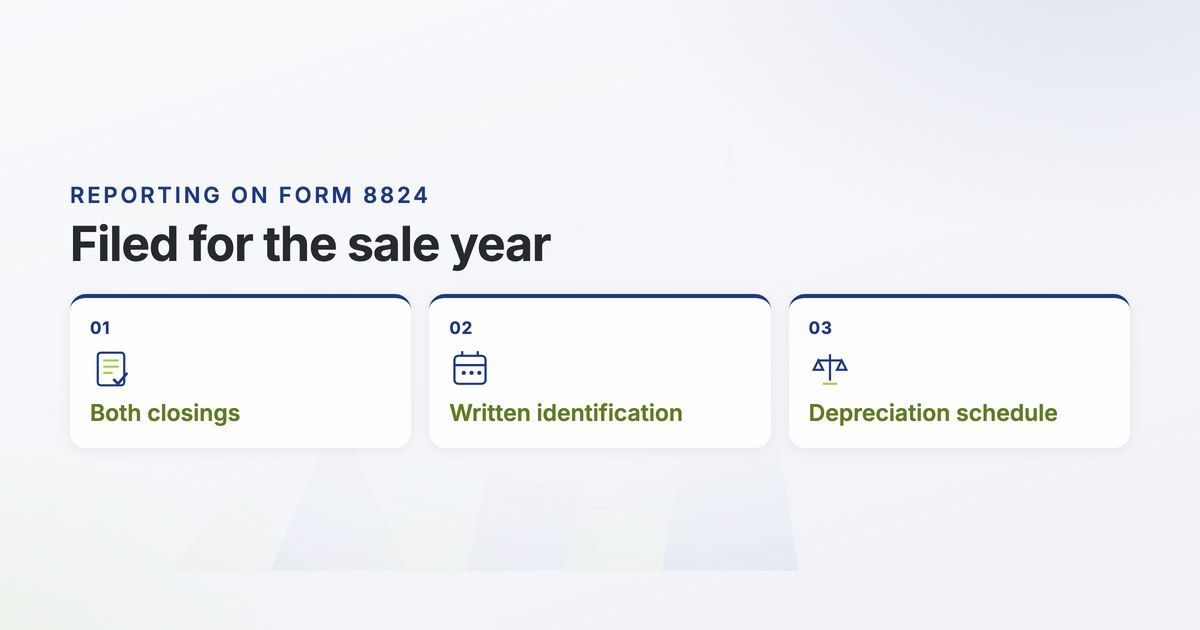
Your accountant will want the closing statement for the property you gave up and the closing statement for the property you received. Those two documents carry most of the numbers on the form.
They will want the exchange agreement and the assignment documents, which establish that the transaction was structured as an exchange rather than as a sale followed by a purchase.
They will want the written identification you delivered inside the 45 day window, with its date, because the dates on the form have to match the dates in the file.
They will want the intermediary's accounting of funds received and disbursed, including anything that came back to you at the end.
And they will want your depreciation schedule for the property you gave up, which is the one item that never comes from us and is the one most likely to be missing.
The three numbers that decide the form
Most of Form 8824 is arithmetic, and three inputs drive it.
The first is your adjusted basis in the property you gave up. That is the original cost plus improvements minus depreciation taken, and it is why the depreciation schedule matters. We wrote up the mechanics separately in depreciation recapture, because recapture is the part of a 1031 that surprises people most at filing time.
The second is boot. Cash you received, debt relief that was not replaced, and non like-kind property all count, and boot is the reason a deferred exchange can still produce a taxable amount. Our post on what boot is and how it is taxed covers the ways it appears, and a partial exchange is the case where boot is deliberate rather than accidental.
The third is the fair market value of what you received. Together with the first two, that produces both the deferred gain and your new basis, which is the number that carries the deferral forward into the next property.
Why the timing of the form confuses people
Form 8824 is filed with the return for the tax year in which the relinquished property transferred, and for a lot of exchanges that is not the year the exchange finished.
Sell in October, identify in November, close on the replacement in March. The exchange completed in the following calendar year, but it is reported on the return for the year of the sale. That is also why the extension conversation from the start of the exchange comes back around at filing time, because a return that has been extended to accommodate the 180 days is the same return the form goes on.
There is a related point about the intermediary's role that is worth stating plainly. If the timing requirements are missed, the transaction is not an exchange, and it does not become one because the paperwork was prepared as though it were. The IRS instructions address the narrow case where a qualified intermediary defaults because of bankruptcy or receivership, and point to a revenue procedure that may allow the gain to be reported as payments are received. That is a specific remedy for a specific failure, not a general safety net, and it is one more reason to ask how an intermediary holds and protects funds before you hand them over.
What we hand you at the end
The accounting we produce is short and it should answer four questions without anybody having to reconstruct anything.
What came in, and from which closing. What went out, and to which purchase. What, if anything, came back to you, and when. And the dates, all of them, matching the documents.
That last item saves the most time. A file where the transfer date, the identification date and the acquisition date all agree with the closing statements is a file your accountant can work from directly. A file where the identification is undated, or where a wire happened on a different day from the one the settlement statement records, turns into a week of email.
None of this is difficult. It is simply easier to assemble as it happens than to reconstruct in April, which is the whole argument for treating the exchange file as a deliverable rather than as a by-product.
What people get wrong on the form
Four recurring ones, and none of them is exotic.
Filing it in the wrong year. The form belongs with the return for the year the relinquished property transferred, even where the replacement property was received in the following calendar year.
Forgetting it entirely. An exchange that completed perfectly and was never reported is not a reported deferral. The form is how the IRS knows the gain was deferred rather than omitted.
Missing the depreciation schedule. Without it the adjusted basis is a guess, and a guessed basis follows the property for as long as you own it.
Assuming e-filing needs the old attachments. The IRS added lines 12a, 15a and 25a through 25c to e-filed forms, and its Instructions for Form 8824 now state that e-filers no longer need to attach a separate sheet providing details for those lines. If your preparer is still assembling attachments out of habit, that changed after 2023.
One further note for anyone who exchanged a property that was partly a home. The instructions describe a write-in space on line 19 for an amount excluded under section 121, and that interaction is genuinely fiddly. It is an accountant question rather than an intermediary one.
Multiple exchanges in one year
If you completed more than one exchange in the same tax year, the IRS allows a summary on a single Form 8824 with your own statement attached showing the requested information for each exchange. That is worth knowing before your preparer starts building one form per transaction.
It also means your intermediary's accounting has to be per exchange rather than aggregated, which is a request worth making at the start rather than in April.
Where we fit and where we do not
We hold the funds, prepare the exchange documents, receive the identification, acquire the replacement property and give you a clean accounting at the end. We do not prepare returns, and we do not give filing advice.
What we can do is make sure the file your accountant receives is complete, and that nothing in the structure creates a problem the form then has to explain. Almost every difficult 8824 we hear about traces back to a decision made months earlier, usually at closing. The full sequence is on our page for how the 1031 exchange process works, and if you want to know what the whole thing costs before you start, what an exchange costs sets that out.
If you have a sale coming and you would rather ask before you file than after, ask us before you file.
FAQ
What is form 8824 used for?
It reports a like-kind exchange to the IRS. Parts I, II and III report the exchange, calculate the gain being deferred, calculate any gain that must be recognized in the current year where cash or non like-kind property was involved, and establish the basis of the replacement property. Part IV is unrelated to real estate and covers section 1043 conflict-of-interest sales by certain federal officials.
Do you have to file form 8824 every year?
Only for a year in which you completed an exchange, with one exception. Where the exchange was made with a related party, the form is also filed for each of the two years following the year of the exchange so the related party disposition questions can be answered. Outside that, no exchange in the year means no Form 8824 in the year.
How to fill out form 8824?
This is your tax preparer's job rather than your intermediary's, and the IRS publishes line by line Instructions for Form 8824 that your preparer will work from. Your part is supplying the inputs, which are both closing statements, the exchange and assignment documents, the written identification with its date, the intermediary's accounting of funds, and the depreciation schedule for the property you gave up.